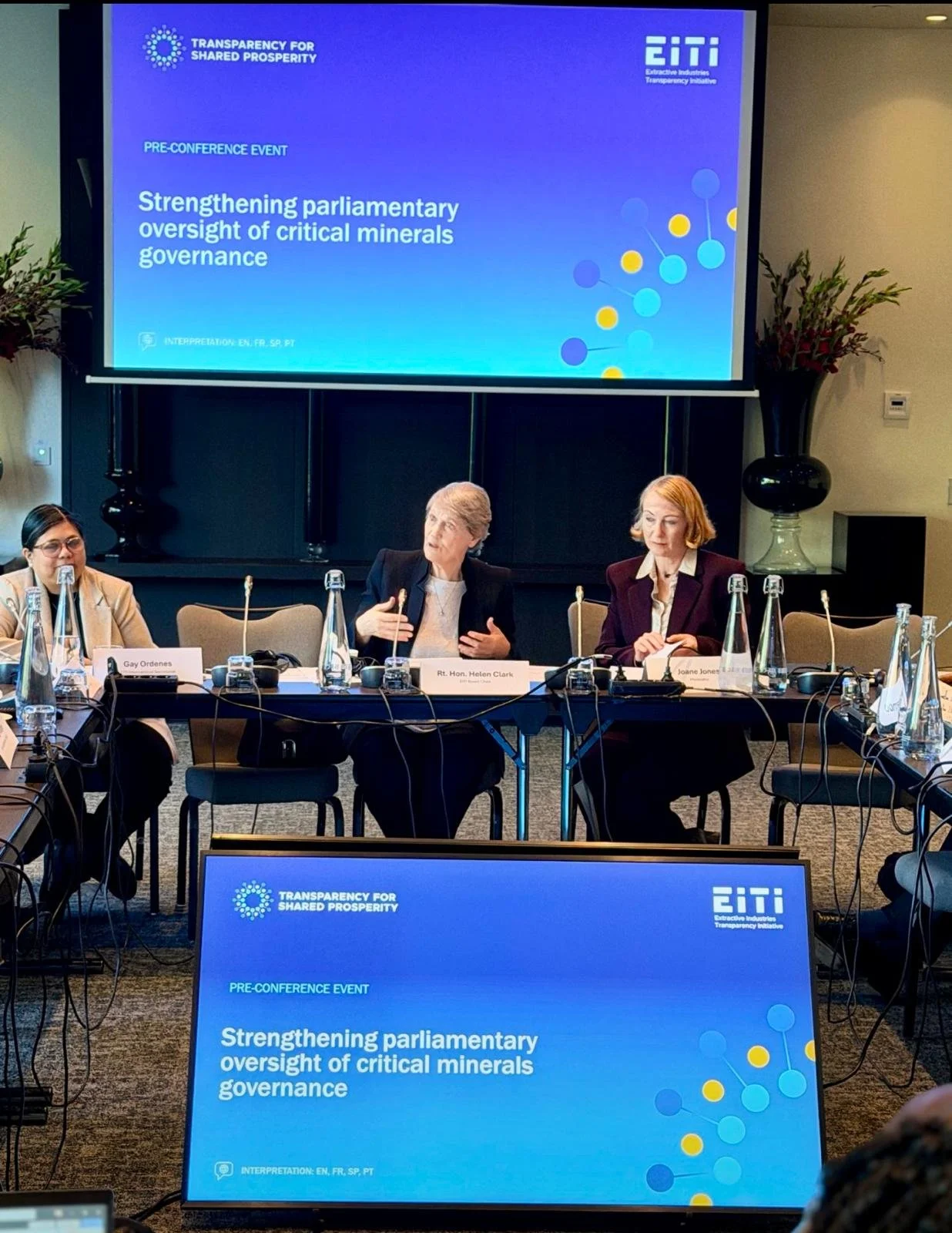
Strengthening Parliamentary Oversight of Critical Minerals Governance
5 October 2026
Earlier today, I had the honour of opening the Parliamentarians Roundtable in Brussels. You can read my full opening remarks below:
Rt Hon. Helen Clark, EITI Board Chair.
Opening remarks at Parliamentarians Roundtable on “Strengthening Parliamentary Oversight of Critical Minerals Governance”.
Brussels, 10 am, Monday 5 October 2026
Excellencies, Members of Parliament, representatives of partner organisations, ladies and gentlemen.
It is my pleasure to open this roundtable on strengthening parliamentary oversight of critical minerals governance. I am delighted that this event is part of the programme for the EITI’s Global Conference week.
Those of you who have travelled from beyond Europe are here with colleagues from the European Parliament and international organisations. This diversity in the room matters.
That is because the critical minerals agenda is a global one. Its value chains cross borders and connect producing countries with consumers, investors, manufacturers, and markets around the world. That makes dialogue between countries along the supply chain vital.
The EITI has convened this discussion at a time of significant change:
- The energy transition is accelerating demand for the minerals which are essential for renewable energy generation.
- Disruption to fossil fuel supply chains is prompting countries to focus on the resilience of their energy systems to external shocks.
- This is happening at a time of growing demand overall for energy as the global population grows, developing country economies expand, and the demands of new technologies for energy soar.
- At the same time, geopolitical competition is reshaping trade and investment patterns, and
- Governments are seeking greater security and resilience in critical mineral supply chains.
For resource-rich countries, this changing landscape creates opportunities. New investment can generate government revenues, jobs, infrastructure, and opportunities for economic diversification. Countries also have an opportunity to capture greater value from their natural resources and strengthen their domestic industries.
But these opportunities also come with critical governance challenges and risks where agreements are reached in a hurry and are opaque. Governments are entering new strategic partnerships; companies are expanding investment; licensing and project development are accelerating; and international expectations around responsible sourcing, due diligence, and environmental sustainability are evolving. What could possibly go wrong….
The decisions being made now will not only shape how minerals are produced and traded, but also who benefits from them, and how the risks and costs are managed.
This is where the role of parliaments is crucial. Through law-making, budget scrutiny, and investigations, parliamentarians can strengthen governance and accountability in the extractives sector. They can demand that resource wealth actually contributes to human and sustainable development.
But effective parliamentary engagement will depend on access to trusted and reliable information. Parliamentarians need to know how natural resources are governed and revenues are managed, and whether the benefits of resource development are reaching the wider economy and society. The data generated through EITI processes is highly relevant to the role parliamentarians must play.
For over two decades, the EITI has brought governments, companies, and civil society together to improve transparency and accountability in the extractives sector. The EITI Standard represents their consensus to date on the requirements for disclosing and publishing information to ensure public accountability.
Emerging legislation, policy frameworks and market standards in resource rich countries must reinforce the importance of due diligence, responsible sourcing, environmental and social governance, and public reporting. The European Union's Critical Raw Materials Act is example of the new policy frameworks emerging around critical minerals in consumer countries.
These frameworks affect companies operating across borders, producers seeking access to international markets and governments negotiating investment and trade partnerships.
Producer countries need to ensure that resource extraction contributes to national development priorities and creates lasting benefits for citizens.
For consumer countries, there is a responsibility to support sustainable supply chains, and the governance and development priorities of producing countries.
For companies, there is an increasing expectation that investment should be accompanied by responsible business conduct, transparency, and respect for environmental and social standards.
Parliaments have an important role in these discussions. They help shape the legal and policy frameworks governing the sector extractives. They review how public revenues are managed and whether national development priorities are benefiting from resource extraction. They are a platform for public debate and can give voice to citizens’ interests and concerns. They can also help ensure that international commitments and national policies are translated into practice.
At today’s roundtable, there are opportunities to learn about different ways in which parliaments are playing their roles around extractive sector governance and scrutiny, and about how the EITI processes can help. You will hear from parliamentarians from Africa, Asia, Latin America, the Pacific, and Europe.
As the demand for critical minerals continues to grow, the question is whether their production can be governed in ways which support sustainable development, protect the public interest, and ensure that the wealth created is shared fairly.
The quality of governance will shape whether the energy transition and the extraction of the critical minerals which enable it become a source of shared prosperity – or of conflict and division. Parliaments have an important role in making positive outcomes possible.
I wish you all fruitful discussions.
Thank you.