Foundation Circle 2025 Conference Speech
16 September 2026
What will unleash the potential for human and sustainable development for all? How will South-South co-operation develop? Can we be more innovative in models of public financing, and what role can enhanced philanthropy play? What will enable stepped up private investment in countries short of capital? Can we build partnerships across the ecosystem of solidarity so that our collective effort is greater than the sum of its parts?
Please see my full speech below ⬇️
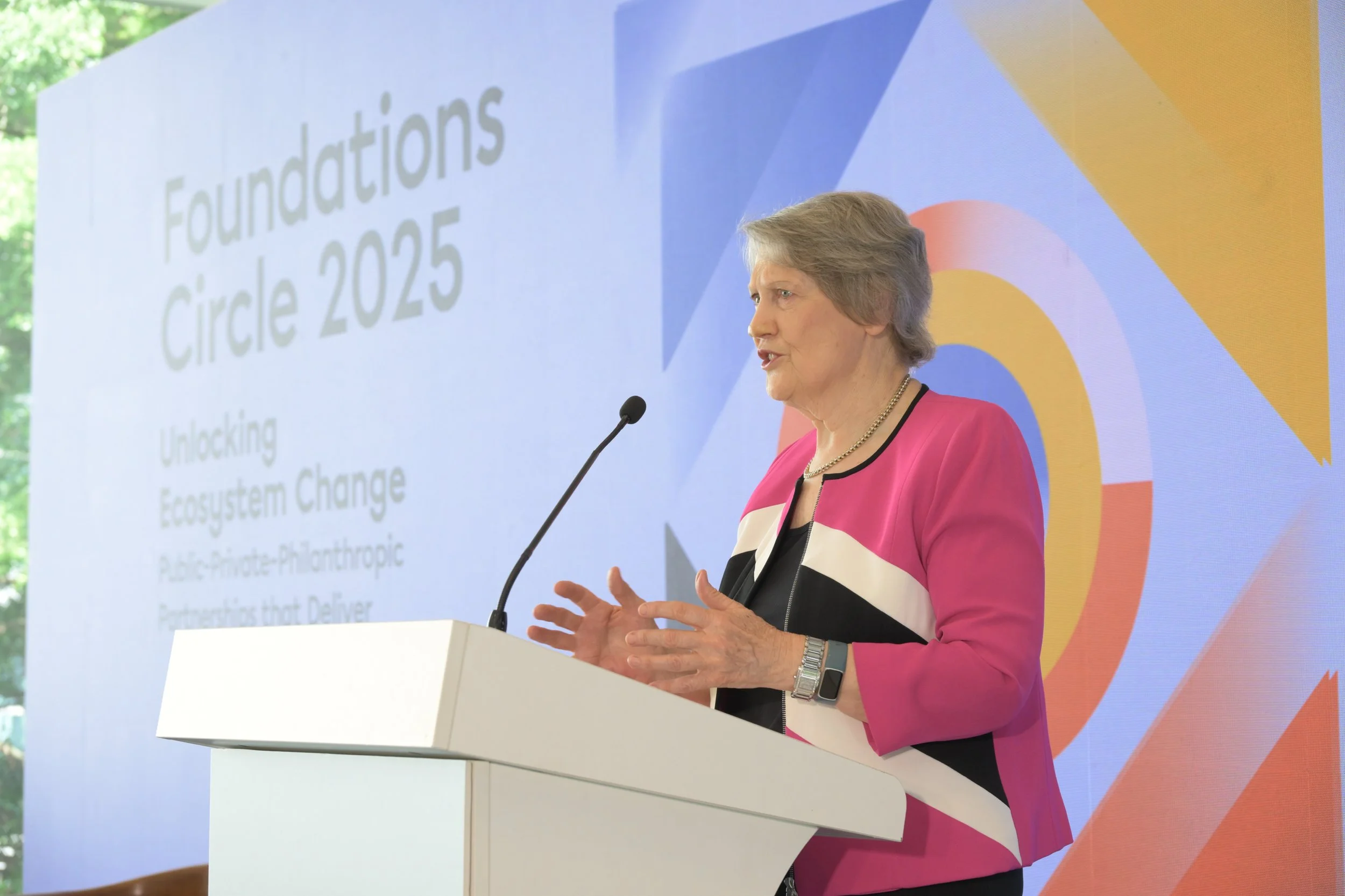
Rt Hon Helen Clark. Keynote address to Foundations Circle 2025 Conference on partnerships for development. Hong Kong, 10 September 2025.
Many thanks for inviting me to this year’s Foundations Circle. This is a highly significant gathering of philanthropic leaders from the region and further afield. Never has the need for your efforts been greater.
We live in a world beset by crises, but also in one which has never had so much wealth and so much potential to transform at pace.
We have seen stunning human development results – not least in China where the fast rise of hundreds of millions of people out of poverty within a few decades has been nothing short of remarkable. A good deal of the Asia-Pacific has seen a similar transformation.
But at the global level, and in parts of our own region, the current syndemic of crises continues to hold many people back. At the Partnership for Maternal, Newborn and Child Health which I chair, we coined the phrase - the “Three Cs crisis” - when the pandemic struck in 2020. COVID-19, the climate crisis, and the growing impact of conflicts set development back globally, keeping progress towards the Sustainable Development Goals well off track.
While we are well past the emergency phase of COVID-19, we live with its long tail of more heavily indebted countries and thus less fiscal space to make progress on critical investments for development – across health, education, social protection, and infrastructure and the broader enabling environment for investment and growth.
The need for climate finance for adaptation and mitigation is great, but supply currently falls well short of what is required.
More and more extreme climate disasters are destroying lives and livelihoods, and disrupting economies and societies. Insurance brokers Aon and Gallagher put the economic cost last year at between $348 and $402 billion dollars. Swiss Re estimates that insured losses from climate disasters could reach $145 billion this year.
Since PMNCH coined the “Three Cs” phrase, the impact of conflicts has accelerated hugely. The scale of suffering in Gaza and Ukraine is widely reported – less so that in Sudan, Myanmar, and elsewhere. The demand for humanitarian relief is great – and much need is unmet.
The world struggles to deal with the consequences of all these crises at the very time when we are entering what I call the beginning of the end of the Official Development Assistance era. Major high-income countries - not only the United States - are cutting their ODA substantially. While ODA could not be expected to flow forever at scale as economies converge, nonetheless its rapid decline now in the face of challenging times places us in a perfect storm of more demand for international solidarity at a time when there is less of it. For low-income countries, the sudden reduction in ODA has been devastating and the projections for the increase in lives lost to preventable diseases like HIV/AIDS and tuberculosis are deeply concerning.
I agree with Minouche Shafik, former Head of the British Department for International Development, that the traditional grant aid which remains is likely to focus on humanitarian needs, global common goods, multilateral finance, and a reduced number of bilateral programmes. But it won’t be enough.
Here's where we must all put our thinking caps on. What will unleash the potential for human and sustainable development for all? How will South-South co-operation develop? Can we be more innovative in models of public financing, and what role can enhanced philanthropy play? What will enable stepped up private investment in countries short of capital? Can we build partnerships across the ecosystem of solidarity so that our collective effort is greater than the sum of its parts?
The truth is that all of the above are needed – there is enough space across the human and sustainable development spheres, response to humanitarian crises, and in climate and biodiversity action and pandemic preparedness and response for all to play complementary roles.
Let me give examples from three organisations with which I am associated on how we are thinking about these issues.
The first comes from The Elders, a grouping of former leaders and eminent personalities founded by Nelson Mandela. We speak of the need for long view leadership which is capable of looking beyond short-term political cycles to address intractable problems and existential threats. In the latter category, we identify the climate and nature crises, pandemic threats, nuclear weapons, and the emerging risks of Artificial Intelligence. All require international collaboration across regions and political systems. We are all in this together.
The financing required for global common goods like climate action and pandemic preparedness and response must be assembled across actors and through innovative means. The Elders are taking an interest in the concept of Global Public Investment which proposes a new model of public finance for addressing these common goods – whereby all countries would contribute according to their means, all would have a say in the governance of the funds, and allocation would be according to need. The Independent Panel for Pandemic Preparedness and Response made a proposal along these lines for funding in that area.
Such a model would require countries to agree to be levied – in a similar way to how the United Nations and its peacekeeping budget and the World Health Organisation’s base programme are financed.
The current model of voluntary fund mobilisation for vertical funds around global common goods has hitherto drawn a lot of support from philanthropy and from the ODA budgets of high-income countries. But as those ODA budgets reduce, philanthropy cannot bridge the gap – hence broadening the base of country contributions through the Global Public Investment approach has merit. One can also note that many low- and middle-income countries do make contributions now, including via co-payments to access funding.
Needless to say, private finance will also play a major role in climate action via investments in the green economy. There are many private sector champions for this. They do need governments to play their part through setting the direction and rules around reaching net zero. I will speak to the role of philanthropy later.
My second example comes from the Extractive Industries Transparency Initiative (EITI) which I chair. Founded 22 years ago, EITI is a government, industry, and civil society partnership which sets the global standard for governance in the extractives sector. More than fifty countries, including a number in Asia implement the Standard which requires high levels of transparency around extractive sector contracts, beneficial ownership, payments, and other data, with the aim of keeping corruption at bay and ensuring that the sector makes its full contribution to government revenues and development.
It goes without saying that such good governance builds the enabling environment for private investment which is badly needed for development. As domestic resource mobilisation becomes ever more important to finance development, a growing economy with solid private investment is critical for mobilising funding for public investment in human and sustainable development.
My third example comes from the Partnership for Maternal Newborn and Child Health (PMNCH) which I also chair. PMNCH is calling for reimagining private-public-philanthropic partnerships for maternal and child health. In a roundtable in Davos this year, we heard of inspiring action to address challenges like postpartum haemorrhage which is the leading cause of maternal death. Private sector commitment to innovate to solve entrenched challenges together with public and philanthropic funding can form powerful alliances for women’s and children’s health. The success of Gavi – the Vaccine Alliance, which has prevented an estimated 18.8 million deaths since 2000 is also testament to the power of such partnerships.
Let me come now to the importance of philanthropy in Asia. As this audience knows well, Asia has its own rich history of charitable giving. Building on that, the region now has philanthropy on a large scale, with the potential to grow even bigger. Many companies in the region are doing extremely well, and there are fast growing numbers of very high net worth individuals. We must encourage more of the legacy of that success to be reflected in philanthropy. This will be a huge asset to human and sustainable development.
It is estimated that if Asian donors were to match the two per cent of GDP of charitable giving in the United States, $702 billion would be mobilised. Current estimates of the level of philanthropy in the region tend to fall far short of that.
While the Asia-Pacific is a fast growing and dynamic region, it is also home to nearly half of the households in the world which live in poverty. Philanthropy has a role to play in ensuring that all are able to benefit from the region’s growth and development. This is positive for long term economic and social stability too. Supporting women’s, youth, and local entrepreneurship, as a number of foundations do supports inclusive growth and poverty eradication. These models can also be adapted and taken to scale.
I am told that Asian philanthropy already tends to work closely with governments, and that funders are increasingly recognising that collaboration should be extended to civil society and local communities too. In that way philanthropy can act as a connector between local, national, and regional level actors to build whole of system approaches.
Responding to the climate crisis is an obvious area of need for this kind of approach. The ecological and energy transitions must be fair and just transitions – or they will fail to serve all the people. And there is much to be done at the community level to mitigate disaster risk of all kinds. Asia is seen as the world’s most disaster-prone region. This requires responses at all levels to keep communities safe.
As philanthropy in Asia scales up, it is seen to be adopting strategic, and data- and impact-driven models. Its role will not be to be the biggest funder, but it can be the most exciting funder, willing to innovate and looking for the partnerships which can amplify its impact. No one actor can bring about transformation, but working together across the public, private and philanthropic spheres, and working from the community level up, partnerships have the power to bring about profound change for people and planet.
I look forward to hearing more today about the direction which philanthropy in Asia is taking. The way philanthropy contributes to human and sustainable development is of global interest and we can all learn from the innovation in this region.
Thank you.