Opening remarks at 10th EITI Global Conference, Brussels
8 October 2026
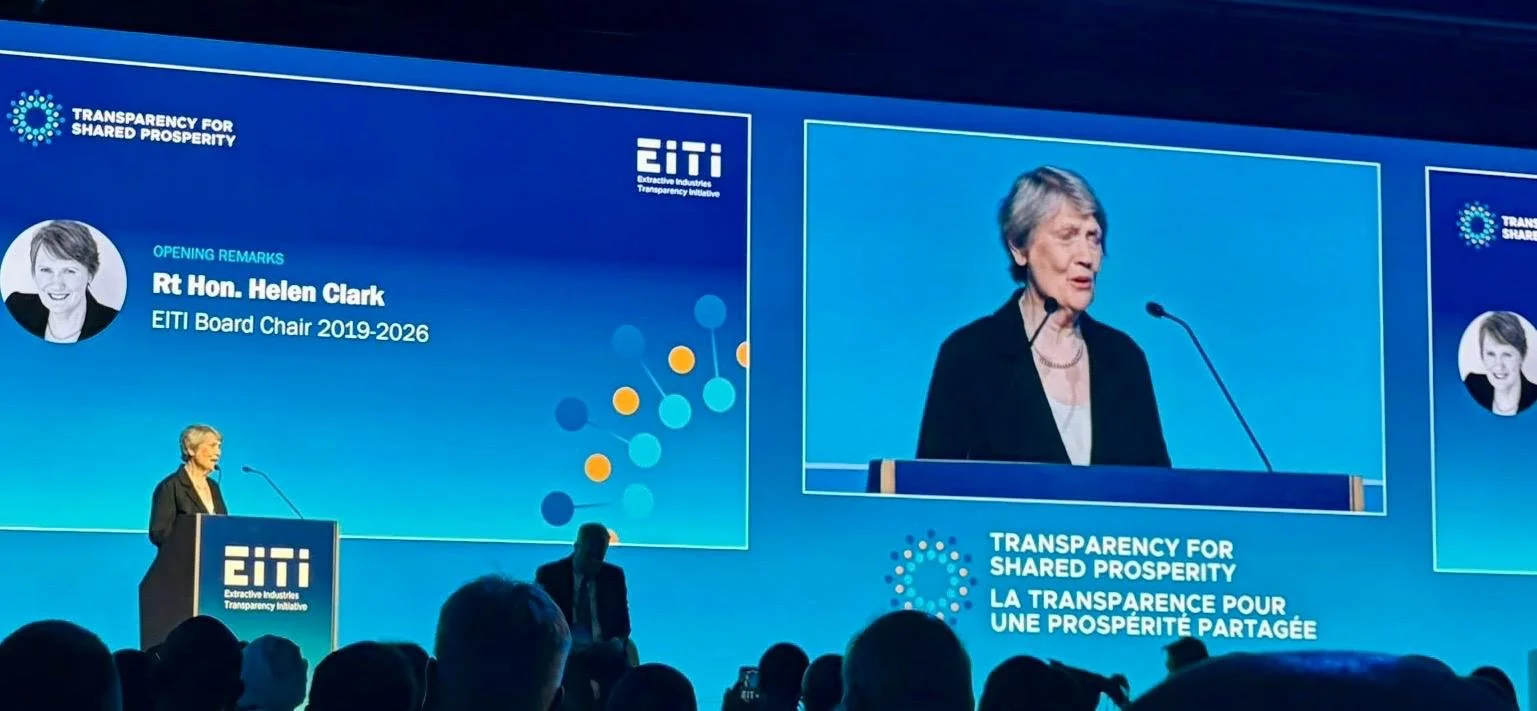
As the outgoing Chair of the EITI Board, I had the pleasure of opening the 10th EITI Global Conference in Brussels.
I wish Maria van der Hoeven, the new Board, the International Secretariat and the whole EITI family every success in its next phase. Please always regard me as a friend of the organisation and a champion of its mission. I will be looking forward to hearing what you are achieving in the years ahead.
You can read the full speech below.
Rt Hon. Helen Clark, Outgoing Chair of EITI Board.
Opening remarks at 10th EITI Global Conference, Brussels.
Thursday 8 October 2026.
It is a great pleasure to welcome you all to this tenth EITI Global Conference.
Let me begin by thanking the Government of Belgium and the European Commission for their generous support in hosting us here in Brussels. We are very grateful for their partnership, and for the warm welcome extended to the EITI community.
We gather here in times of global turbulence which impact on the work of the EITI and its membership across constituencies.
The context for managing extractive industries is becoming increasingly complex and unpredictable.
The current conflict in the Gulf has heavily impacted on oil and gas supply from that region, and also created opportunities for other producers.
As well it has more countries thinking about how they can build greater resilience around their energy supplies, including through renewables. That could add momentum to the ongoing energy transition away from fossil fuels.
This is happening at the same time as the demand for energy is accelerating from, for example, growing populations, emerging and developing economies, and the proliferation of major energy-hungry data platforms.
Well before the Gulf crisis, the race was on for access to the critical minerals needed for the energy transition, resulting in more bilateral agreements and strategic resource partnerships.
For resource-rich countries, this creates opportunities to attract investment, but also added pressure to ensure that natural resource wealth delivers lasting benefits for citizens.
That means that good governance matters more than ever. The decisions made on access to resources today will shape whether developing countries and their peoples share the benefits. The transparency, accountability, and informed public dialogue which the EITI processes support are all the more necessary.
Well-governed extractive sectors can contribute to stability, economic and social development, and broader prosperity. Poorly governed sectors will deepen existing challenges and inequalities.
Transparency is not an obstacle to energy security, investment, or economic development. Done well, it is one of their foundations.
This global conference marks the end of my seven years as the Board Chair of EITI. These have been fascinating years for me, building on the achievements of those who have gone before.
From its inception 23 years ago, the EITI community has grown significantly, and the scope and ambition of the EITI’s work has evolved - both in response to new challenges, and as the organisation has lifted the bar on what is disclosed in the interests of best practice governance of extractives. Requiring beneficial ownership disclosure was a major step forward, complementing contract transparency, revenue disclosure, and transparency around commodity trading and state participation in the sector.
Since 2003, around USD 3.6 trillion in government revenues have been disclosed in open format through EITI reporting across more than 50 implementing countries. That is an extraordinary scale of information, which should contribute to informed debate about the extractive sector in EITI implementing countries.
The 2023 update to the EITI Standard also brought environmental and social considerations much more firmly into the conversation about how natural resources are governed.
While there is much to celebrate, old challenges remain and new ones have emerged. Linear progress on transparency can never be taken for granted. The race for access to critical minerals does create significant governance risks. Implementation of the EITI Standard must continue to be strengthened, and more effort must be made to ensure that information disclosed through the EITI actually does inform public debate, strengthen accountability, and contribute to improved outcomes for citizens.
One of the EITI’s greatest strengths is its ability to bring governments, companies, and civil society to the same table. That doesn’t necessarily make for easy conversations at the global board or in a national multi-stakeholder group, but these are essential conversations for advancing the EITI’s mission. Yet, civic space is under pressure globally, including in a number of EITI implementing countries. It is vital that the EITI continues to stand for the right of civil society to participate freely and frankly in all EITI processes.
I brought to this Board Chair role the experience of many years in leadership at the national and global levels, which included a focus on good governance, economic and social inclusion, environmental protection, and sustainable development overall. It was a pleasure in this role to stay associated with so many countries I had worked with during my years at UNDP – both implementing countries and supporting countries.
Over chairing more than twenty Board meetings, roughly half of them online and others in various locations around the world, and during a number of very informative country visits, I have learned a lot about extractives, and also about multi-stakeholder governance which I carry with me into other board chair assignments.
My thanks go to all board members with whom I have worked, to all those who have hosted our board meetings and missions, and to the EITI Secretariat staff, led by Mark Robinson who has been a very close colleague and advisor. Our staff are professional and mission-driven, and it has been a pleasure to work with them all. A special shout out goes to retiring Deputy Executive Director, Bady Balde, whose deep knowledge of implementing countries has been very helpful to me. Congratulations to Gisela Granada, Bady’s worthy successor.
As I hand over to Maria van der Hoeven and a new Board, I do so knowing that the EITI is a strong and going concern, and that its mission is highly relevant to the times in which we find ourselves.
I wish Maria, the new Board, the International Secretariat and the whole EITI family every success in its next phase. Please always regard me as a friend of the organisation and a champion of its mission. I will be looking forward to hearing what you are achieving in the years ahead.
Thank you and all the best.